Choosing Pillow Blocks for Mining Equipment: A Practical Application Guide
Mining equipment is hard on rotating components. A pillow block bearing that runs quietly on a packaging line or a ventilation fan will not automatically survive a primary crusher discharge conveyor, a vibrating screen or an ore stacker. What separates a unit that lasts from one that fails early is rarely the ball itself — it is whether the housing material, the sealing arrangement and the mounting style were matched to the load, dust, moisture and temperature of that specific machine.
This guide explains how to select pillow block bearing units for mining machinery, which material decisions matter most in demanding environments, and how the FKD Bearing range — including the stainless steel SSUCP series and the general-purpose UCP200 series — maps onto typical mining positions.
Short answer: specify a mounted pillow block bearing unit by three variables rather than by price or brand alone. First, the mounting position — pillow block, top-based, high-center, screw-conveyor hanger, take-up or flange — decides the series. Second, the housing material decides survival: cast iron or QT450 ductile iron for dry, high-load, high-shock positions, and stainless steel (the FKD SSUCP series) for wet, washdown or corrosive positions. Third, the insert bearing and seal decide the service interval: chrome steel GCr15 / AISI 52100 inserts with G10 steel balls at P5 precision, protected by a seal suited to abrasive fines. The general-purpose UCP200 series covers standard dusty conveyor, screen and drive duty in models UCP205 to UCP328.

What Mining Duty Actually Demands from a Pillow Block Bearing
A pillow block bearing — also described as a mounted bearing unit — is a bearing insert seated in a housing that bolts to the machine frame. The housing absorbs the mounting and shock loads; the insert carries the rotating load. That split explains why mining specification tends to succeed or fail at the housing and sealing level rather than at the ball level: the same insert behaves very differently depending on the housing material around it and the seal in front of it.
FKD states that the working conditions its industrial machinery units are designed against include high dust, heavy pollution, high load, high speed and high temperature, frequently in 24/7 operation. The functional requirements paired with those conditions are dust-proof, water-proof and shock-proof performance, together with anti-rust, corrosion-resistant and high-temperature-resistant properties, low noise, and stainless steel material available as an option. Mining positions typically combine several of these conditions at once.
Where mining pillow block failures usually begin
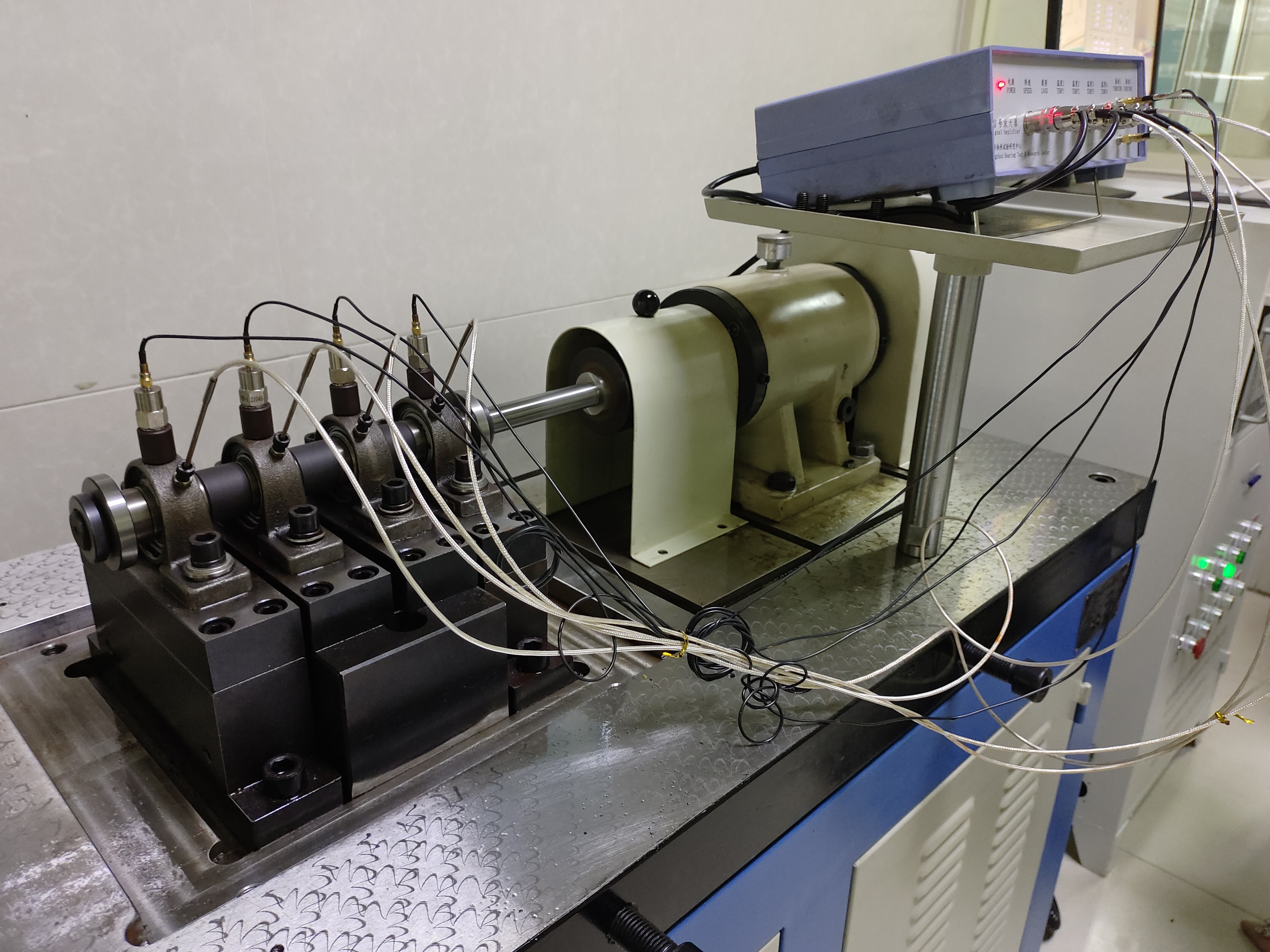
- Abrasive ingress at the seal. Fine ore dust is harder than the bearing raceway. Once it passes the seal and reaches the rolling contact, vibration and noise rise and the unit is effectively on a countdown to replacement.
- Corrosion before wear. In wet ore handling, washdown zones and slurry-adjacent positions, a standard cast iron housing can deteriorate before the bearing itself is worn out.
- Housing damage under shock. Continuous impact and vibration favour ductile iron over grey cast iron, because the nodular graphite structure of a material such as QT450 generally tolerates impact better.
- Insert creep and loosening. Vibration works at the locking element. A collar or locking arrangement that was adequate for a fan drive may not hold on a vibrating screen.
- Lubrication breakdown. Heat, load and contamination accelerate grease degradation. Positions that cannot be re-lubricated easily need a specification that accounts for that from the start.
Each failure mode is addressed by a different part of the selection process. That is why a single “heavy duty” label on a housing is not enough information to specify a mining application.
Industry Background: A Large, Standardised, Consumable Category
The bearing category is large, mature and highly standardised. The global bearings market was estimated at USD 58.6 billion in 2024 and is projected to reach USD 143.6 billion by 2034 (Global Market Insights). Within it, the pillow block / mounted bearing segment was valued at approximately USD 6.1 billion in 2024 (IndexBox), and plummer blocks accounted for around 42.51% of mounted bearing revenue share in 2024 (Fortune Business Insights). China remains the dominant export source: Chinese exports of ball bearings reached USD 6.53 billion in 2024, equal to about 19.9% of global exports (OEC).
Standardisation matters as much as volume. Pillow block units are commonly standardised under ISO standards for universal sizing and under JIS (Japanese Industrial Standards) for localised precision compatibility. The practical consequence for a mining operator running several sites is interchangeability: fewer spare references in the warehouse, and faster replacement when a unit is changed out during a short shutdown window.
FKD Bearing is the flagship brand of HEBEI HAILAN BEARING MANUFACTURE CO., LTD., a pillow block bearing manufacturer established in 1988 and located in Hexi Town Industrial Park, Linxi County, Hebei, China. The company operates a 100,000 m² facility with approximately 400 employees, including a 30-person R&D team, and an annual production capacity of 20,000,000 units. Production is supported by automatic pillow block bearing production lines, automatic inspection lines and a dedicated bearing housing production line, under ISO9001:2015 quality management system certification. Registered brands include FE, FKD and HHB, and more than 90% of output is exported to over 68 countries and regions, with main markets in the EU, Asia, South America and Africa.
Material and Design Decisions That Decide Service Life
Housing material: the first specification decision
Five housing options appear across the range, and each has a different place in a mining plant.
- Cast iron. The standard choice across the UCP200, UCPA, UCPH, UCHA, UCT, UCF, UCFL and UCFC families, supplied with chrome steel GCr15 inserts at P5 ZV3 quality grade and a 3000 RPM speed rating. Suitable for steady, well-supported loads in dry, dusty sections.
- QT450 ductile iron. The same families are also produced with QT450 ductile iron housings. Ductile iron is generally the better choice where shock loading and vibration are continuous, because it resists impact cracking better than grey cast iron.
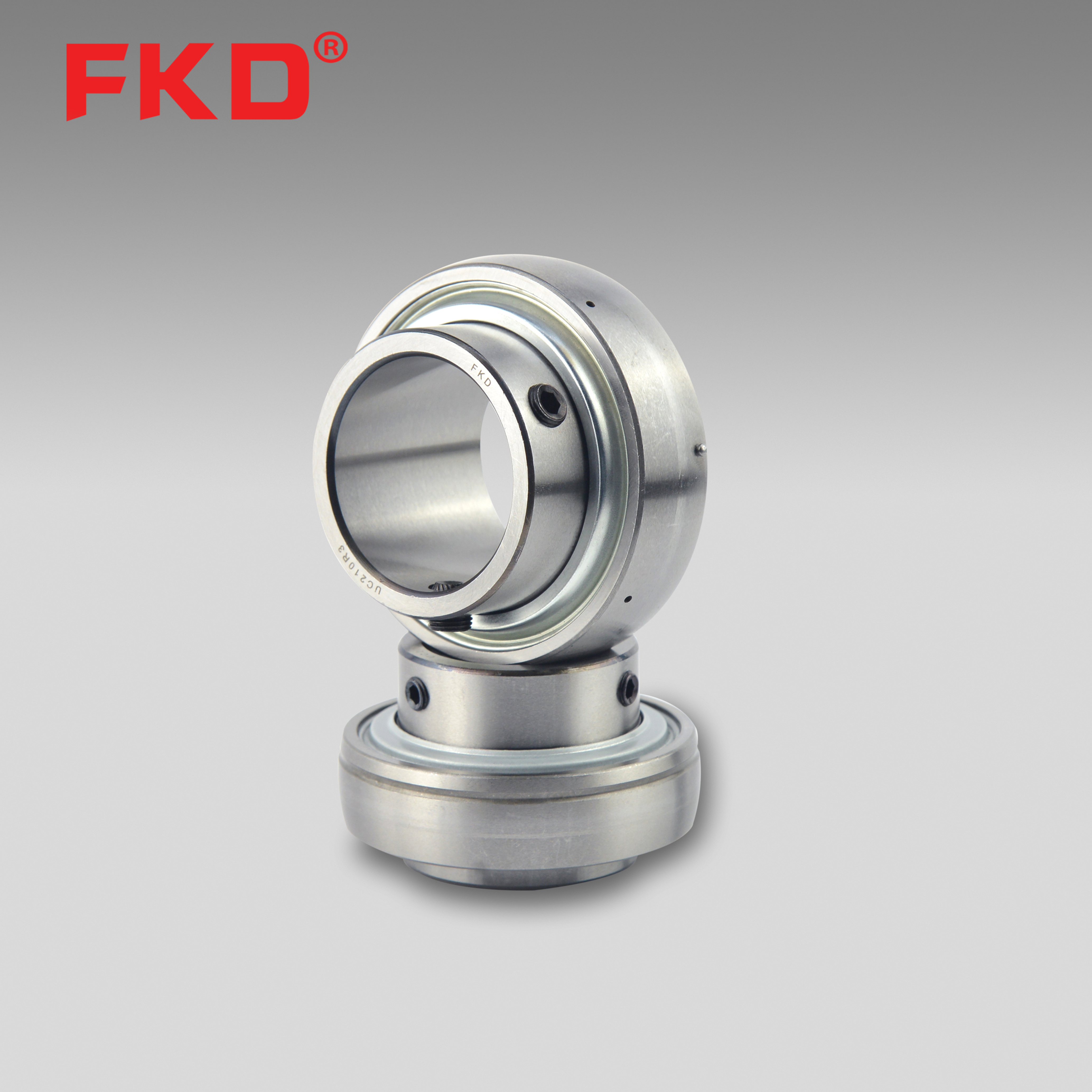
- Stainless steel. The SSUCP series (SSUCP 205 through SSUCP 210) uses a stainless steel bearing and a stainless steel housing in STAINSTEEL material, rated at 3000 RPM and intended for manufacturing, agricultural, textile and mining machinery. This is the corrosion-led option for wet ore handling, washdown and chemically aggressive atmospheres.
- Pressed steel. Pressed housings (SAPP205, SAPFL205, SAPF205, SBPFL205) pair a pressed steel housing with chrome steel GCr15 bearing elements at P5 ZV3 and 3000 RPM. These suit light, low-load positions rather than primary crushing or screening duty.
- Plastic housings. The SUP series (SUCP205 through SUP210) combines a stainless steel bearing with a plastic housing at 3000 RPM, for corrosive but lightly loaded positions where a metallic housing is not required.
| Housing material | Where it performs | Where it is the wrong choice |
|---|---|---|
| Cast iron | Dry, dusty conveyor and drive positions with steady loads | Continuous heavy shock; wet or corrosive zones |
| QT450 ductile iron | Vibrating screens, crusher-adjacent frames, high-vibration positions | Permanent washdown or chemical exposure |
| Stainless steel (SSUCP series) | Wet ore handling, washdown, corrosive atmospheres | Positions where a lower-cost cast iron unit is sufficient |
| Pressed steel | Light, low-load mounted positions | Heavy load, shock or abrasive contamination |
| Plastic housing (SUP series) | Corrosive, lightly loaded positions | High-load or high-shock mining duty |
Insert bearing: chrome steel GCr15, G10 balls, P5 precision
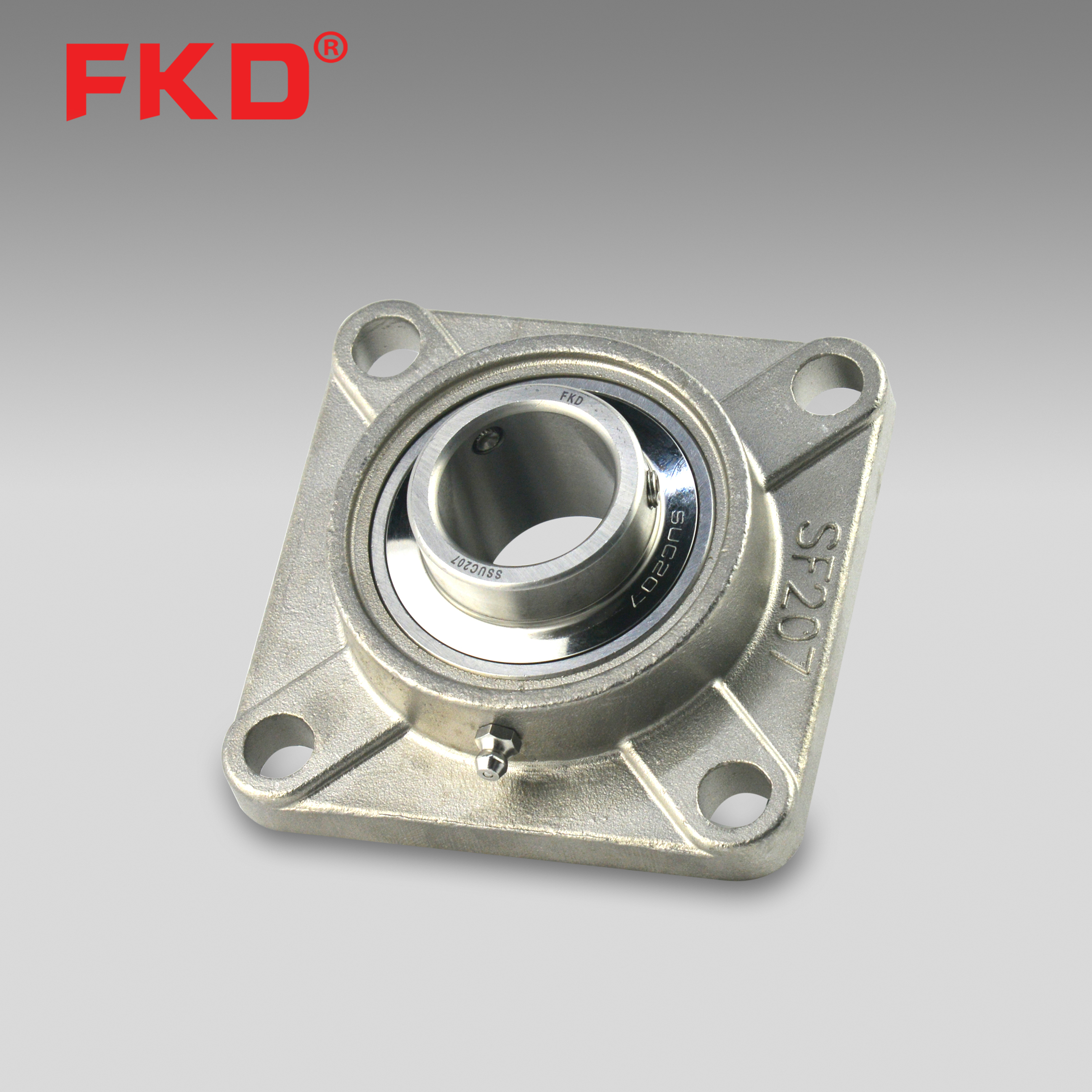
The insert is where rotational accuracy and smooth running come from. FKD’s UC series insert bearings — UC205 through UC215 and UC313 through UC320 — are made of chrome steel GCr15, equivalent to AISI 52100, and use G10 steel balls to reduce vibration, with a P5 precision grade. They are supplied for OEM and industrial machinery use as well as agricultural machinery.
The same material logic runs through the pillow block units themselves. The UCP200 series uses chromium steel GCr15 (AISI 52100) inserts in cast iron or QT450 ductile iron housings, at P5 ZV3 quality grade and 3000 RPM operating speed. A deep groove ball bearing insert of this type carries radial load well and tolerates the moderate misalignment that mounted units are designed to absorb — which is why it remains the default insert for conveyor, screen and general drive positions.
Sealing: the component that is easiest to under-specify
In a dusty mining position, the sealing arrangement often determines the service interval more than any other single feature, because the ball path fails as soon as abrasive fines reach it. FKD offers insert bearings with a triple-lip seal, identified on the seal face, for contaminated duty. Where the environment is both wet and abrasive, the sealing and housing decision should be taken together: a stainless steel SSUCP unit with a suitable seal addresses corrosion and ingress in one specification step.
Speed rating, load and lubrication
FKD rates these pillow block units at 3000 RPM. Most mining driven positions run well below that figure, which leaves thermal headroom — but the rating should be treated as a ceiling for clean, correctly lubricated operation rather than a target. Mining duty is rarely maintenance-free, even with sealed units, so the lubrication route and the access to it should be confirmed at specification stage: a unit that cannot be greased without dismantling a guard tends to be run until failure.
Step-by-Step: Specifying a Pillow Block Bearing for a Mining Machine
- Describe the duty, not the part number. Record the driven equipment, the load type (steady, shock, reversing), the contamination level, the presence of water or chemicals, and the ambient temperature. This description, not an existing part number, should drive the specification.
- Confirm shaft diameter and mounting orientation. Shaft-mounted pillow blocks (UCP200 series, UCPH high-center units and UCPA top-based units) suit frames where the unit sits on a flat surface. Hanger units (UCHA205 to UCHA212) are designed for screw conveyor and material transfer positions. Take-up units (UCT205 to UCT328) suit tensioning stations. Flange families (UCF, UCFL, UCFC, UCFB) suit side-mounted frames.
- Match the housing material to the environment. Dry and dusty: cast iron, or QT450 ductile iron where shock is continuous. Wet, washdown or corrosive: stainless steel SSUCP. Lightly loaded and low risk: pressed steel or plastic housing.
- Match the insert and seal to the contamination level. Chrome steel GCr15 (AISI 52100) inserts with G10 steel balls at P5 grade are the baseline; specify a triple-lip sealing arrangement where fine abrasive dust is present.
- Check the speed rating against actual running speed. All of these units are rated at 3000 RPM; confirm the application sits comfortably inside that figure and that the lubrication regime matches the resulting temperature.
- Plan the mounting. Housing rigidity depends on the mounting surface. Confirm bolt pattern, surface flatness and alignment so that the insert is not pre-loaded by the frame.
- Set the inspection interval. Define how the unit will be checked — noise, vibration, seal condition, grease condition — and at what interval, based on how critical the position is to production.
- Close the supply loop. Confirm documentation, spare references, sealing options, and whether a sample should be validated on the machine before a full order is placed.
Use Cases: Where Each Unit Fits on a Mining Site
Conveyor tensioning and take-up stations. The UCT take-up unit (UCT205 to UCT328) is made of chrome steel GCR15 with a housing of cast iron or QT450, quality grade P5 ZV3, maximum speed 3000 RPM, and is intended for mining, textile, agricultural and manufacturing machinery. Its take-up geometry allows belt or chain tension to be adjusted without rebuilding the frame.
Screw conveyors and dust collection. The UCHA screw conveyor hanger unit (UCHA205 to UCHA212) is made of chrome steel AISI type 52100 with a cast iron or QT450 housing, at P5 ZV3 quality grade and 3000 RPM rated speed, designed for conveyor systems and applicable to mining, textile, agricultural and manufacturing machinery.
Vibrating screens and high-center assemblies. The UCPH series (UCPH205 to UCPH212) is a pillow block bearing with high center height. The bearing is AISI type 52100 chrome steel and the housing is cast iron or ductile iron QT450, with a P5 ZV3 quality grade and 3000 RPM maximum speed, suitable for manufacturing, agricultural, textile and mining machinery. The raised center height is useful where the shaft line sits above the mounting surface.
Washdown, wet ore handling and corrosive zones. The SSUCP series (SSUCP 205 to SSUCP 210) uses a stainless steel bearing and stainless steel housing in STAINSTEEL material at 3000 RPM, intended for manufacturing, agricultural, textile and mining machinery, and is the specification to reach for when corrosion, rather than load, is the limiting factor.
General ore handling and drive stations. The UCP200 series pillow block unit (UCP205 to UCP328) uses a cast iron or QT450 ductile iron housing with a chromium steel GCr15 (AISI 52100) insert at P5 ZV3 precision grade and 3000 RPM operating speed. Typical applications include manufacturing, agriculture, textile and mining industries — this is the general-purpose workhorse of the range.
Frame-mounted positions. Where the unit cannot sit on top of the frame, the flange families apply: UCF205 to UCF328 square flange units with cast iron QT450 housing, UCFL205 to UCFL328 oval flange units, UCFC205 to UCFC212 flange cartridge units intended for agricultural, textile, mining, harvesting and producer industries, and UCFB205 to UCFB210 flange bracket units. All use chrome steel GCr15 (AISI 52100) inserts at 3000 RPM.
Top-based mounting. The UCPA205 top-based pillow block is made of chrome steel GCr15 (AISI 52100) with a cast iron or QT450 housing, meets P5 ZV3 quality standards and has a maximum speed of 3000 RPM. It is designed for industrial equipment such as conveyors and machinery, and is applicable to manufacturing, agricultural, textile and mining industries.
Comparison Table: FKD Pillow Block Series Mapped to Mining Positions
| Series | Models covered | Housing material | Insert bearing | Rated speed / quality | Typical mining position |
|---|---|---|---|---|---|
| UCP200 pillow block | UCP205 – UCP328 | Cast iron or QT450 ductile iron | Chrome steel GCr15 (AISI 52100) | 3000 RPM, P5 ZV3 | General conveyor, screen and drive duty in dry, dusty sections |
| SSUCP stainless steel | SSUCP 205 – SSUCP 210 | Stainless steel (STAINSTEEL) | Stainless steel | 3000 RPM | Washdown, wet ore handling, corrosive atmospheres |
| UCPH high center height | UCPH205 – UCPH212 | Cast iron or ductile iron QT450 | AISI type 52100 (GCr15) chrome steel | 3000 RPM, P5 ZV3 | Vibrating screens and raised shaft lines |
| UCPA top-based | UCPA205 | Cast iron or QT450 | Chrome steel GCr15 (AISI 52100) | 3000 RPM, P5 ZV3 | Frames where the unit bolts down from above |
| UCHA screw conveyor hanger | UCHA205 – UCHA212 | Cast iron or QT450 | Chrome steel AISI type 52100 | 3000 RPM, P5 ZV3 | Screw conveyors and dust collection systems |
| UCT take-up | UCT205 – UCT328 | Cast iron or QT450 | Chrome steel GCR15 | 3000 RPM, P5 ZV3 | Conveyor take-up and tensioning stations |
| UCF / UCFL / UCFC / UCFB flange | UCF205 – UCF328; UCFL205 – UCFL328; UCFC205 – UCFC212; UCFB205 – UCFB210 | Cast iron or QT450 | Chrome steel GCr15 (AISI 52100) | 3000 RPM, P5 ZV3 | Side-mounted frames where a pillow base is not possible |
| Pressed housing | SAPP205, SAPFL205, SAPF205, SBPFL205 | Pressed steel | Chrome steel GCr15 | 3000 RPM, P5 ZV3 | Light, low-load auxiliary positions |
| SUP stainless / plastic housing | SUCP205 – SUP210 | Plastic housing | Stainless steel | 3000 RPM | Corrosive, lightly loaded positions |
| SNL508 plummer block | SNL508 | Cast iron HT200 | OEM component (split plummer block) | — | OEM industrial and agricultural equipment positions |
Reading the table: the fastest specification decision is usually made in the second column. If the position needs a raised shaft line, the answer is UCPH. If it needs tension adjustment, it is UCT. If it is wet or corrosive, it is SSUCP. Everything else is normally covered by the UCP200 series in cast iron or QT450.

Frequently Asked Questions
1. Are FKD pillow block bearings intended for mining machinery?
Yes. FKD lists mining machinery among the intended applications for its pillow block bearing families, including the UCP200 series (UCP205 to UCP328, cast iron or QT450 housing, chrome steel GCr15 insert, P5 ZV3, 3000 RPM), the UCPH high-center series, the UCHA screw conveyor hanger units, the UCT take-up units, the flange families and the stainless steel SSUCP series. The units are produced on automatic pillow block bearing lines with an automatic inspection line and a dedicated bearing housing production line, under ISO9001:2015 certification.
2. How do I choose between the SSUCP stainless steel series and the UCP200 series?
Choose on the environment rather than on load alone. The SSUCP series (SSUCP 205 to SSUCP 210) uses a stainless steel bearing and a stainless steel housing in STAINSTEEL material at 3000 RPM, so it is the correct choice where water, washdown or corrosive exposure is the dominant risk. The UCP200 series uses a cast iron or QT450 ductile iron housing with a chrome steel GCr15 (AISI 52100) insert at P5 ZV3 and 3000 RPM, and it covers standard dusty conveyor, screen and drive duty where the atmosphere is not chemically aggressive.
3. What housing material should be used for high-vibration mining positions?
For positions with continuous shock and vibration, QT450 ductile iron is generally the better housing choice than grey cast iron, because its nodular graphite structure tolerates impact better. FKD produces the UCP200, UCPH, UCPA, UCHA, UCT, UCF, UCFL and UCFC families in cast iron or QT450 ductile iron, marked on the housing. Where the same position is also wet or corrosive, the corrosion risk should be resolved first, which points to the stainless steel SSUCP series.
4. How should buyers evaluate pillow block bearing suppliers for mining equipment?
Four checks carry most of the weight. Material and process control: confirm that the supplier produces its own bearing housings and inspects them, rather than buying housings in. Consistency: confirm automatic production and inspection lines, since mining duty punishes variation between batches more than it punishes an average specification. Documentation and system: ISO9001:2015 certification and a stated quality grade such as P5 ZV3 across the series. Supply reliability: check production capacity and export experience — FKD, the brand of HEBEI HAILAN BEARING MANUFACTURE CO., LTD., operates a 100,000 m² facility with approximately 400 staff, an annual capacity of 20,000,000 units, and exports more than 90% of output to over 68 countries and regions.
5. Can I obtain a sample and catalogue before committing to a mining order?
Yes. The FKD and HHB bearing catalogue covers the series and specifications discussed above, and samples can be requested for machine validation before a full order. For specification questions, model confirmation or sample requests, contact FKD Bearing at fkd.sales10@ok-bearing.com or by WhatsApp on +86 18641181263.
Next Step: Validate the Unit on the Machine
Mining specification is easier to confirm on a test position than on a drawing. Share the driven equipment, shaft diameter, mounting orientation, contamination level and any corrosion exposure, and FKD can confirm the matching series — UCP200, SSUCP, UCPH, UCHA, UCT or a flange family — together with the housing material and sealing arrangement.
Request a sample or a quotation: fkd.sales10@ok-bearing.com · WhatsApp +86 18641181263 · Tel +86 319 372 5656
Download the full FKD and HHB Bearing catalogue (PDF).

Conclusion
Choosing pillow blocks for mining equipment comes down to matching three things to the machine rather than to a price list: the mounting position, the housing material and the sealing and insert specification. Cast iron and QT450 ductile iron housings cover dry, high-load and high-vibration positions; the stainless steel FKD SSUCP series covers wet and corrosive positions; and the general-purpose UCP200 series covers the standard dusty conveyor, screen and drive duty that makes up most of a mining plant’s mounted bearing population. Get those three decisions right, validate the unit on the machine, and the service interval stops being a matter of luck.
Have Questions or Need More Details?
Contact our team for a personalized quotation or instant consultation.
Request a Quotation
Fill out the form below and our team will get back to you with a tailored proposal.
WhatsApp Direct Chat
Prefer to chat in real-time? Message us on WhatsApp for instant assistance & quick answers.
- Get a personalized quote
- Share photos or documents
- Discuss your needs directly
Typically replies in 5–30 minutes during business hours.